Specialties · Rhinology
Turbinate hypertrophy: when the nose will not clear
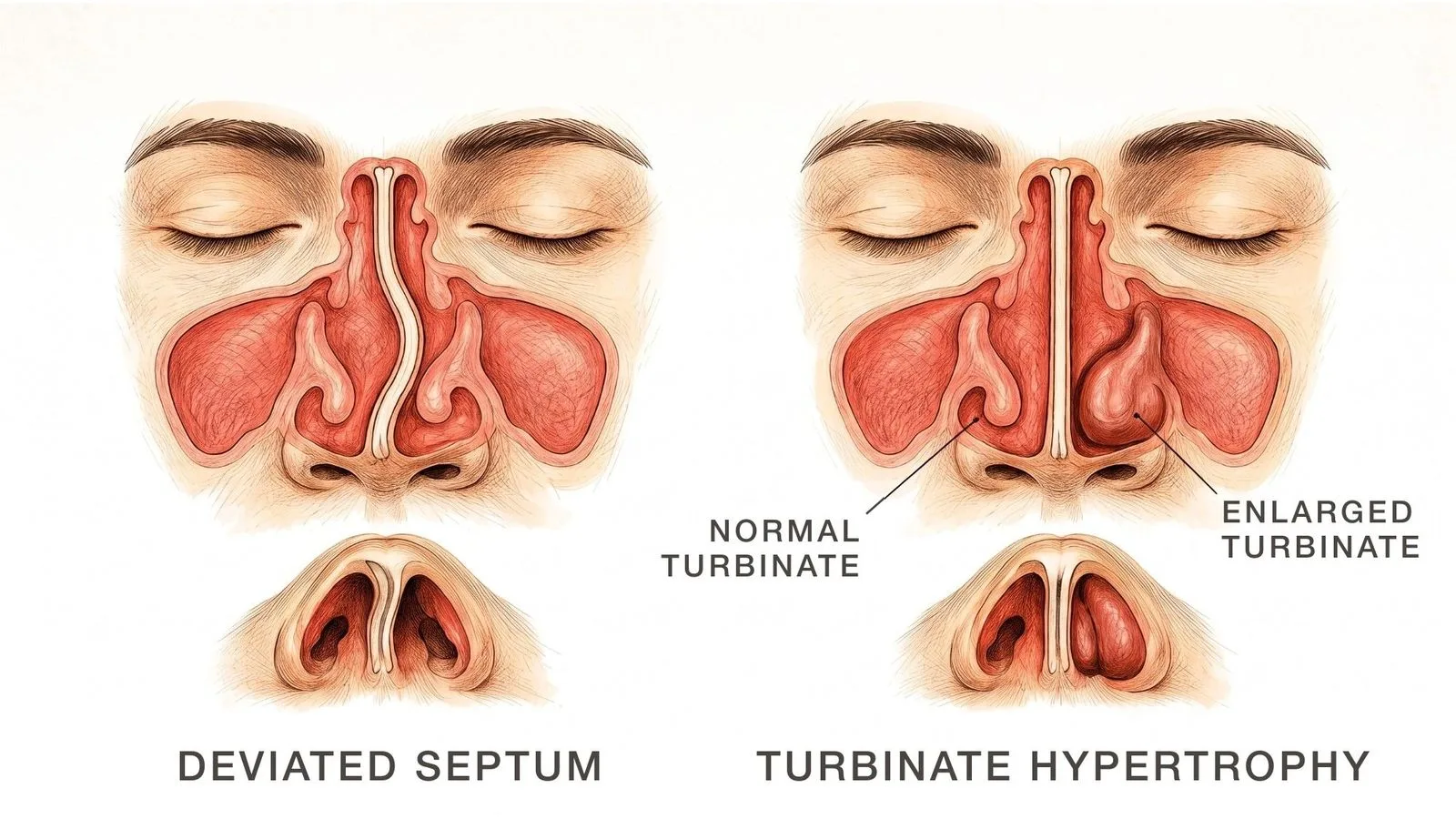
Turbinate hypertrophy is the enlargement of the structures inside the nose that warm and humidify the air. When enlarged, the turbinates narrow the airway and leave the nose blocked. The most common cause is rhinitis. Treatment starts with medical control, and surgical reduction is considered when the obstruction persists.
Medically reviewed by Prof. Aline Bittencourt, MD, PhD, CRM-MA 7562 · RQE 1832 Updated on
What is turbinate hypertrophy?
The turbinates are elongated structures on the inner side walls of the nose. They are covered by a lining rich in blood vessels that warms, humidifies and filters the air before it reaches the lungs. Turbinate hypertrophy means they are enlarged, taking up too much space and narrowing the airway.
It is normal for the turbinates to swell and shrink through the day, alternating sides. This alternation is called the nasal cycle, and most people never notice it. Hypertrophy is different: the enlargement is constant and the nose is blocked most of the time.
What causes turbinate hypertrophy?
-
Allergic rhinitis, the most common cause: the lining reacts to dust mites, dust, animal dander or mould and swells.
-
Non-allergic rhinitis, triggered by strong smells, smoke, air conditioning or changes in temperature.
-
Prolonged use of decongestant nose drops, which causes a rebound effect (rhinitis medicamentosa). To tell whether a product is a decongestant, check the active ingredient on the pack. The most common, with some brand names sold in Brazil:
- Naphazoline hydrochloride: Neosoro, Sorine Adulto, Naridrin (adult drops), Sorinan Adulto, Narix Adulto and Sinustrat Vasoconstritor.
- Oxymetazoline hydrochloride: Afrin (adult or paediatric drops) and Aturgyl.
- Phenylephrine hydrochloride: found in some specific paediatric formulations.
All of them carry a risk of rebound effect and rhinitis medicamentosa. Some of these brands also sell saline-only versions, which are not vasoconstrictors — so what matters is the active ingredient, not the product name.
-
Deviated septum: on the wider side of the nose, the turbinate tends to enlarge to fill the space.
-
Hormonal changes, as in pregnancy, and some long-term medications.
What are the symptoms?
- A blocked nose on both sides or alternating between them, worse when lying down.
- Mouth breathing, dry mouth on waking and snoring.
- Runny nose, sneezing and an itchy nose, when rhinitis is present.
- Frequent need for decongestant to breathe or sleep.
- Reduced sense of smell and a feeling of pressure in the face.
A blockage on one side only that does not improve, with bleeding or blood-stained discharge, should be assessed by an ENT specialist without delay.
How is it diagnosed?
The consultation brings together the history — how long, what makes it worse, which medicines have been tried — and examination of the nose. Nasal endoscopy, done in the consulting room with a thin camera, shows the size of the turbinates, the septum along its full length and whether polyps or discharge are present. During the test the doctor may apply a decongestant and watch how much the turbinate shrinks, which helps decide whether treatment should be medical or surgical. In some cases a CT scan of the sinuses is requested.
Treatment of turbinate hypertrophy
Medical treatment
This is always the first step. It includes saline nasal rinses, corticosteroid nasal spray, control of allergic rhinitis (reducing exposure to allergens and, where indicated, other medicines) and gradual withdrawal of decongestant drops in those who have used it for a long time. Improvement is usually assessed after a few weeks of correct use.
Turbinate surgery
When the nose remains blocked despite well-conducted medical treatment, surgical reduction of the inferior turbinates may be indicated, known as turbinoplasty or partial turbinectomy. The aim is to reduce the turbinate’s volume while preserving the lining, which is responsible for warming and humidifying the air. Removing too much tissue can leave the nose dry, so the technique is conservative.
At Clínica Rhinus, the reduction may be done with coblation, which uses low-temperature radiofrequency. The procedure is done through the nostrils, with no external incision, and is often combined with septoplasty when there is also a deviated septum. For the first few days the nose is swollen and crusted; nasal rinses and follow-up visits for cleaning are part of recovery, and breathing improves gradually.
What about children?
In a child who snores and breathes through the mouth, turbinates enlarged by allergic rhinitis are a frequent cause, often together with enlarged adenoids. Treating the rhinitis is usually enough, and turbinate surgery in childhood is indicated selectively. The topic is covered on the page about snoring and mouth breathing in children.
Sources: Brazilian Association of Otorhinolaryngology and Cervico-Facial Surgery (ABORL-CCF) · Flint PW, Francis HW, Haughey BH, et al. Cummings Otolaryngology: Head and Neck Surgery. 7th ed. Elsevier; 2020. · Bento RF, Bittencourt AG, Voegels RL. Seminários em Otorrinolaringologia. Fundação Otorrinolaringologia.
Frequently asked questions
Questions about rhinology
What are the nasal turbinates?
They are elongated bony structures covered by mucosa, attached to the side walls of the nose. There are three on each side: inferior, middle and superior. They warm, humidify and filter the air we breathe. The inferior turbinate is the largest and the one that most often enlarges and causes obstruction.
Is turbinate hypertrophy the same as a deviated septum?
No. A deviated septum is a change in the wall dividing the two nostrils. Turbinate hypertrophy is enlargement of the structures on the side walls of the nose. Both cause a blocked nose and often occur together, so assessment considers both.
Do decongestant nose drops solve it?
It relieves the blockage for a few hours, but continuous use for more than a few days can cause a rebound effect: the turbinate swells again, sometimes more than before, and the person becomes dependent on the drops. This is called rhinitis medicamentosa and it can be treated. Ideally, decongestants are used only on medical advice.
Is turbinate surgery done together with septoplasty?
Often, yes, when both problems are present. But turbinate reduction can also be done on its own when the septum is not the cause of the obstruction. The indication is defined in consultation.
Can the turbinates grow back after surgery?
Because the technique preserves the lining, the turbinate remains living tissue that reacts to inflammation. If rhinitis is not controlled after surgery, it may swell again. That is why treating rhinitis remains important after the procedure.