Tests · Nose and throat
Nasal endoscopy: seeing inside the nose
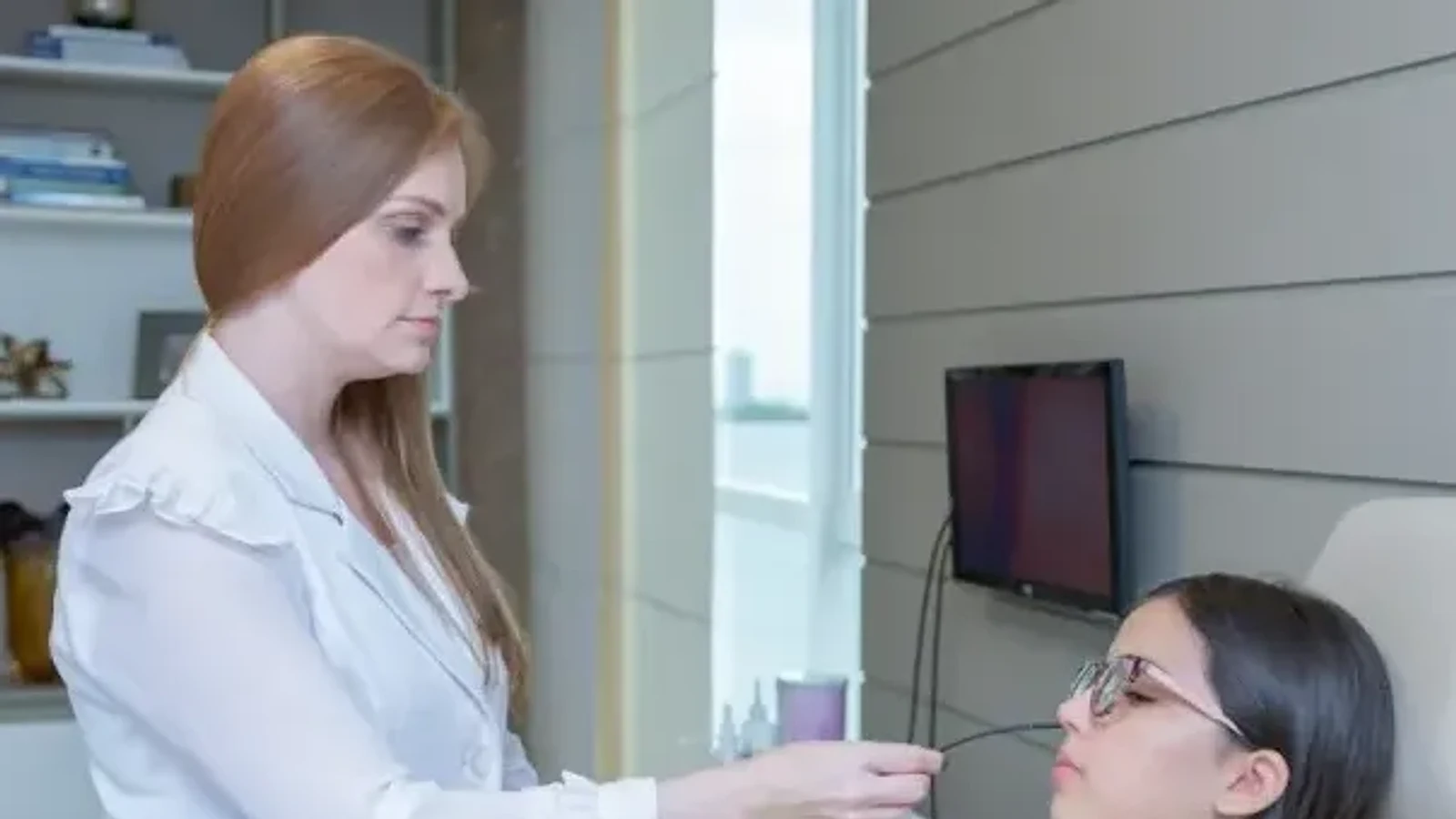
Nasal endoscopy uses a thin camera to travel through the inside of the nose and show what inspection from the front cannot reach: the septum along its full length, the turbinates, the drainage of the sinuses and the adenoids. It is carried out in the consulting room, without anaesthesia, and takes about five minutes.
Medically reviewed by Prof. Aline Bittencourt, MD, PhD, CRM-MA 7562 · RQE 1832 Updated on
What does the test show?
Looking at the nose from the front, with a light, reaches very little: only the first part of the nostrils. Endoscopy goes in and travels the whole way, showing:
- The septum along its full length, including deviations further back.
- The turbinates, and whether they are enlarged.
- The drainage points of the sinuses, and whether secretion is coming from them.
- Nasal polyps, where present.
- The adenoids and how much they obstruct the passage, at the back of the nose.
- The region of the Eustachian tube, which links the nose to the ear.
This is why the test is decisive in chronic nasal obstruction, recurrent sinusitis, snoring and suspected enlarged adenoids.
How is it carried out?
- Introduction of the endoscope, a thin tube with a camera at the tip, through one nostril at a time.
- Assessment of the structures along the whole route.
The test is carried out with the patient seated and awake, without anaesthesia, and takes about five minutes. The endoscope is thin enough to make anaesthetic unnecessary, and that shortens the test: there is no waiting time and no numbness afterwards.
Endoscopy or CT?
| Nasal endoscopy | CT of the sinuses | |
|---|---|---|
| What it shows | The surface, live, and airflow | The bone and the sinuses from within |
| Radiation | No | Yes |
| Where it is done | In the consulting room, without anaesthesia | In an imaging centre |
| When it is preferred | Initial assessment, adenoids, polyps, obstruction | Surgical planning, complicated sinusitis |
One test does not replace the other. They answer different questions.
Where it is carried out
At Clínica Rhinus, in the Renascença district of São Luís, during the consultation with the ENT specialist.
How should I prepare for this test?
- Bring the medical request: it is required for all tests, whether under insurance or self-pay.
- No fasting is needed.
- If you use a nasal spray, continue as usual unless told otherwise.
- Tell us if you take anticoagulants or have frequent nosebleeds.
- With children, explain beforehand what will happen: cooperation reduces discomfort.
Sources: Brazilian Association of Otorhinolaryngology and Cervico-Facial Surgery (ABORL-CCF) · Flint PW, Francis HW, Haughey BH, et al. Cummings Otolaryngology: Head and Neck Surgery. 7th ed. Elsevier; 2020. · Bento RF, Bittencourt AG, Voegels RL. Seminários em Otorrinolaringologia. Fundação Otorrinolaringologia.
Frequently asked questions
Questions about nose and throat
Does nasal endoscopy hurt?
It does not usually hurt, which is why the test is carried out without anaesthesia. The endoscope is very thin and the test lasts only a few minutes. Most people describe a passing sensation of pressure, and watering eyes — not pain. In children, the discomfort comes more from unfamiliarity than from pain.
Can children have it?
They can, and it is the test of choice for assessing adenoids, because it shows their true size and how much they obstruct, without radiation. Cooperation varies with age; where a child cannot cooperate, the physician considers other options.
Do I need to fast?
No. The test is carried out in the consulting room, without anaesthesia and without sedation, so you may eat normally before and immediately afterwards. There is no fasting restriction.
Can I drive afterwards?
Yes. As there is neither anaesthesia nor sedation, you leave the consulting room in normal condition and can return to your routine straight away.