
Nose
A blocked nose all year: rhinitis or a deviated septum?
People who live with a blocked nose for years are usually given two explanations: rhinitis or a deviated septum. Both can be true at once, and treating only one of them explains a good deal of the frustration.
Written by Dr André Jucá, CRM-MA 8213 · RQE 4383 Medically reviewed by Prof. Aline Bittencourt, MD, PhD, CRM-MA 7562 · RQE 1832 Published on
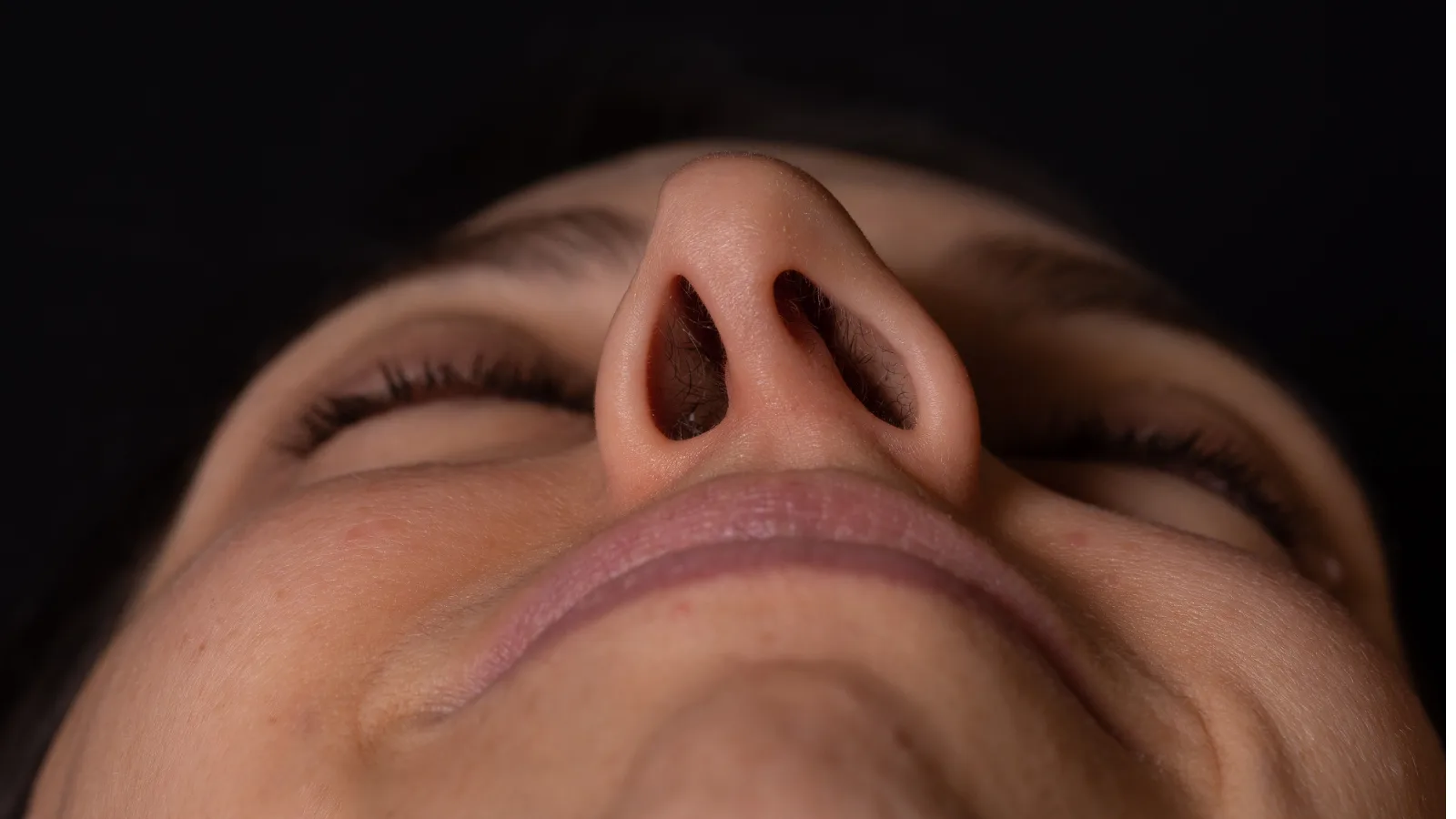
Anyone who has lived with a blocked nose for years has heard both explanations. One doctor said it was rhinitis. Another said it was a deviated septum. And the person still cannot breathe properly.
Both are usually true at once — and that is precisely where the confusion lies.
They are different in kind
A deviated septum is anatomical: the wall dividing the two nostrils is not straight, and that narrows the airway on one side, the other, or both. It is a structural feature that does not change with the weather or the season.
Rhinitis is inflammatory: the lining of the nose swells in response to allergens, dust or a change in temperature. It varies through the day and through the year.
Now put the two together. In a nose with a deviation, the margin for airflow is already small. When the lining swells because of rhinitis, that margin disappears. This is why the same person breathes reasonably one day and wakes up completely blocked the next.
Why this changes management
Operating on a septum without treating rhinitis is one of the commonest routes to post-operative disappointment. The structure improves, the inflammation continues, and the sense of a blocked nose returns within weeks. The conclusion the person draws — “the operation did not work” — is rarely fair to the operation.
The more predictable path is the other way round: treat the rhinitis properly first, for long enough, and then reassess. If obstruction persists once the lining is under control, the contribution of the septum becomes clear and a surgical indication starts to make sense.
What helps tell them apart
Some questions usually guide the consultation:
- Does it vary? Obstruction that changes with the weather, the season or exposure to dust points to the inflammatory component.
- Is it always the same side? Fixed obstruction on one side suggests a structural component.
- Does it come with sneezing, clear discharge and itching? A typical picture of allergic rhinitis.
- Is it worse lying down? Common in both, so it settles nothing on its own.
Nasal endoscopy resolves much of the doubt: it shows the septum along its full length, the state of the turbinates, and whether there are polyps or secretion.
One thing that often goes unmentioned
Decongestant nasal spray, of the vasoconstrictor type, gives relief within minutes — and for that reason becomes a habit. Used for weeks, it produces a rebound effect: the lining swells more as the effect wears off, and the person needs more and more of it.
If you have been using a decongestant spray for more than a few consecutive days, mention it at the consultation. It is not a minor detail: sometimes it is the main cause of the current picture.
When to seek assessment
- A blocked nose that does not improve, at any age.
- Obstruction that interferes with sleep or exercise.
- Recurrent sinusitis.
- Frequent nosebleeds from the same side.
- Continuous use of a decongestant nasal spray.
More on this subject on the page about deviated septum.