
Sleep
Adenoids: when to operate and when to wait
Enlarged adenoids are one of the most common causes of snoring, mouth breathing and ear infections in childhood. Many children improve with medical treatment, and adenoids tend to shrink with age. Surgery is indicated when the obstruction is significant and persistent, or when it is already affecting sleep, the ears or the face. Recovery usually takes 7 to 10 days.
Written by Profa. Dra. Aline Bittencourt, CRM-MA 7562 Medically reviewed by Profa. Dra. Aline Bittencourt, CRM-MA 7562 Published on
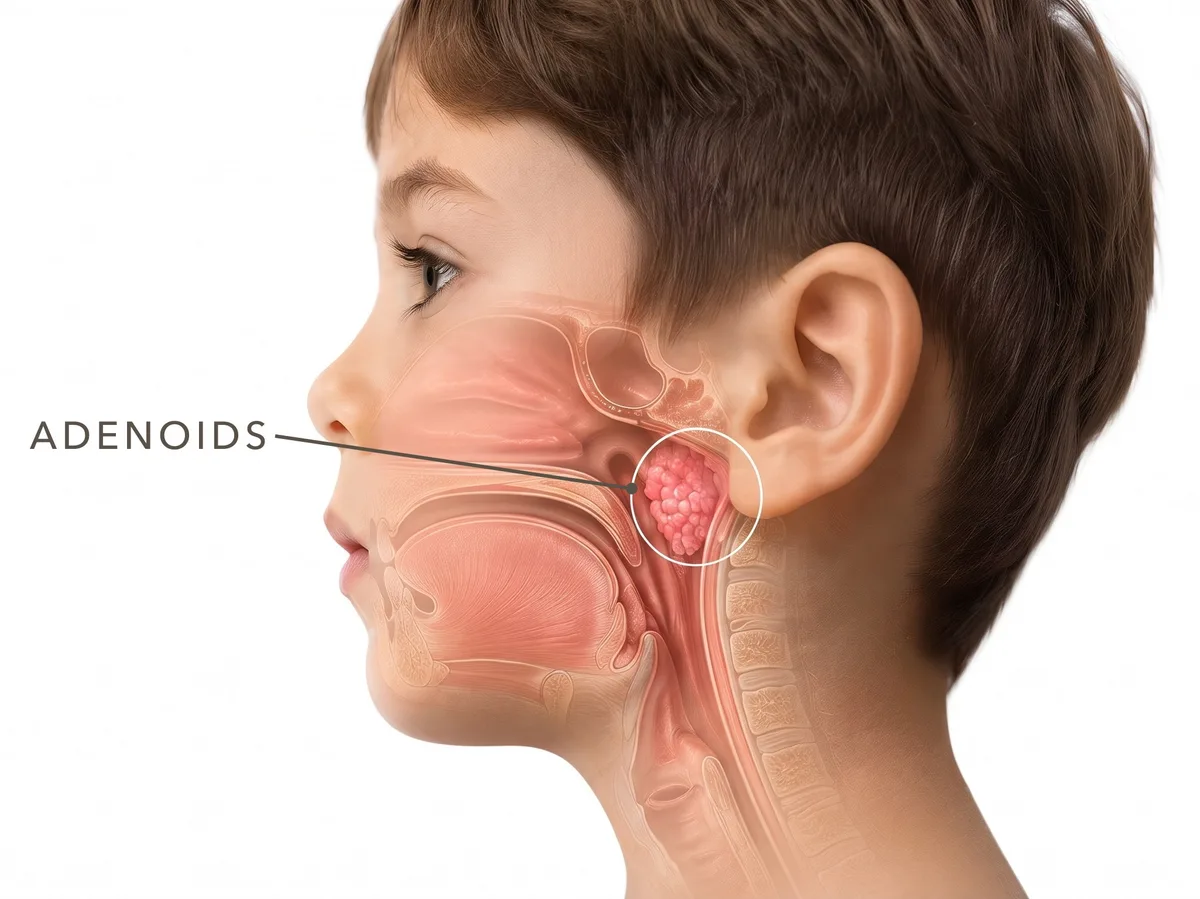
“The adenoids are large.” For many families, that sentence comes with another question: does my child need surgery? The answer depends less on size and more on what the adenoids are causing.
What are the adenoids?
They are tissue similar to the tonsils, at the top of the throat behind the nose, and part of the body’s defence system. They sit where they cannot be seen by looking into the mouth. They grow in the first years of life, are usually largest between 3 and 7 years of age, and tend to shrink after that.
Because they sit in the airway, when enlarged they can block breathing through the nose. And because they are close to the Eustachian tube, the channel that ventilates the ear, they can also favour ear infections.
Which signs suggest enlarged adenoids?
- Snoring on most nights, sometimes with pauses in breathing.
- Mouth open during the day and during sleep.
- A nasal voice, as if the nose were blocked.
- A nose that is blocked or runny most of the time.
- Recurrent ear infections or fluid behind the eardrum.
- Restless sleep, tiredness and inattention during the day.
How is it confirmed?
Suspicion comes from the history and examination. Confirmation is usually made with nasal endoscopy, which shows the adenoids and how much of the airway they take up, without radiation. In some children, a specific X-ray is an alternative.
When snoring is significant or breathing pauses are suspected, polysomnography shows whether there is sleep apnoea and how severe it is. If there are ear infections, tympanometry and audiometry show whether the ear is being affected.
When to wait?
Medical treatment is usually the first step, especially when the obstruction is mild and there is no apnoea or effect on the ears. It includes:
- Saline nasal irrigation.
- Treatment of rhinitis, when present, with topical medication as advised.
- Attention to environmental factors, such as mould, cigarette smoke and dust.
- Reassessment after a few weeks of medication.
Many children improve this way. And because adenoids tend to shrink with age, watchful waiting with follow-up is a legitimate approach in many cases, as long as the symptoms are mild and well controlled.
When is surgery indicated?
Adenoidectomy is considered when:
- The obstruction is significant and persists despite medical treatment.
- There is confirmed or very likely obstructive sleep apnoea.
- Ear infections recur or fluid behind the eardrum does not clear, especially with hearing loss.
- There is recurrent sinusitis related to the obstruction.
No adenoid measurement alone determines surgery. What matters is the whole picture: how the child breathes, how they sleep, how often they fall ill and how the ears are.
What is the surgery like?
Adenoidectomy is done in hospital under general anaesthesia: the child is asleep throughout and feels no pain. The adenoids are removed through the mouth, guided by a camera (endoscope) placed in the nose, which gives a precise view of the area. There are no cuts in the skin.
At Clínica Rhinus, the surgery is performed with coblation, which uses low-temperature radiofrequency energy to remove tissue precisely and in a controlled way. In many cases the child goes home the same day or the next day.
Before surgery, blood tests (full blood count and clotting) are done, along with assessment by the ENT surgeon, a cardiologist and the anaesthetist. When the tonsils also obstruct, they can be removed in the same procedure; when there is persistent fluid in the ear, a ventilation tube can be placed at the same time. The details are on the page about adenoid and tonsil surgery.
What is recovery like?
Recovery from adenoidectomy usually takes 7 to 10 days, with gradual improvement:
| Period | What to expect |
|---|---|
| Days 1 and 2 | Blocked nose, mouth breathing, nasal voice, bad breath and mild throat discomfort |
| Days 3 to 5 | Thick green or brownish nasal discharge, low fever and restless sleep |
| Days 5 to 7 | Nasal breathing and breath improve; streaks of blood in the discharge may occur |
| Days 7 to 10 | Gradual return to normal nasal breathing and usual activities |
In the first days, food should be cold or at room temperature and soft, avoiding hot, acidic and crunchy foods. Saline nasal rinses help keep the nose clean and ease the blockage. Strenuous exercise waits until medical clearance, and the first follow-up visit is about 7 days after surgery.
Can the adenoids grow back?
It can happen, but it is uncommon. The tissue removed does not fully regrow, and any regrowth is usually small. If symptoms return, a new assessment shows the cause, which is not always the adenoids: rhinitis, for example, also blocks the nose.
If your child snores, breathes through the mouth or always has a blocked nose, the page on the child who snores and mouth breathes explains the other causes and how assessment works.