
Ear
Tympanoplasty: surgery to repair a perforated eardrum
Tympanoplasty is the operation that closes a perforated eardrum with a graft of the patient's own tissue. Its main goal is to keep the ear dry and protected from infection; better hearing is a possible gain, assessed after healing. Recovery usually takes 2 to 4 weeks, with the ear kept away from water.
Written by Profa. Dra. Aline Bittencourt, CRM-MA 7562 Medically reviewed by Profa. Dra. Aline Bittencourt, CRM-MA 7562 Published on
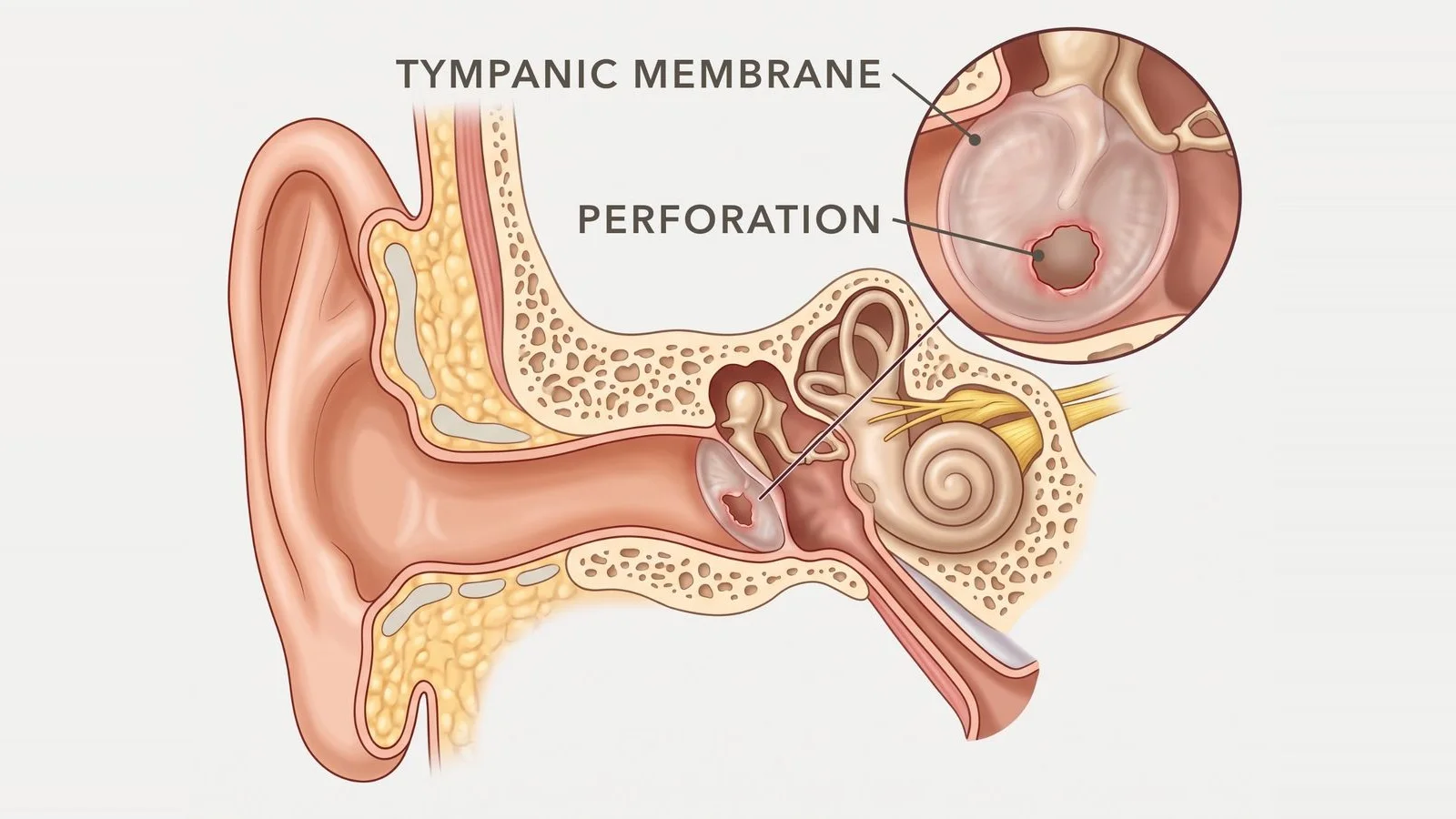
An ear that discharges every so often, an infection that returns after swimming in the pool or the sea, cotton wool always in the ear to keep water out in the shower. For many people with a perforated eardrum, this has been the routine for years. When the perforation does not close on its own, tympanoplasty is the treatment.
What is tympanoplasty?
The eardrum is a thin membrane that separates the ear canal from the middle ear, the small cavity that holds the ossicles, the three tiny bones that carry sound. When the eardrum is perforated, the middle ear is exposed to water and germs, and hearing may drop.
Tympanoplasty closes the perforation. The operation has two goals:
- Closing the eardrum, restoring the barrier in front of the middle ear.
- Improving hearing, when the loss is caused by the perforation or by the ossicles.
The main goal is a dry ear, free of infection. Better hearing matters, but it is considered a secondary goal: it depends on the condition of the ear and can only be assessed after healing.
When is surgery indicated?
- A perforation that does not heal on its own, even after medical treatment.
- Chronic otitis media, with recurrent discharge and difficulty hearing.
- Conductive hearing loss, when the perforation or damage to the ossicles blocks the passage of sound.
- Infections that return whenever water gets in the ear, in the shower or the pool.
No other treatment can close a perforation that has not healed. Drops and antibiotics control infection, but they do not close the eardrum.
Which tests are done beforehand?
| Test | What it is for |
|---|---|
| Audiometry | Measures hearing and the type of loss, and helps plan surgery |
| Tympanometry | Assesses the eardrum and the middle ear cavity |
| CT scan of the ears, in some cases | Shows whether the disease extends into the mastoid, the bone behind the ear, and the state of the ossicles |
| Blood tests and assessment by a cardiologist and anaesthetist | Confirm that general health allows surgery |
How is the operation done?
Tympanoplasty is performed in hospital under general anaesthesia: the patient is asleep throughout and feels no pain. It takes about an hour and a half on average and is done with a surgical microscope or an endoscope.
- Access to the eardrum, through the ear canal or a small incision behind the ear, depending on the size and position of the perforation.
- A graft of the patient’s own tissue, taken from around the ear: the fascia, a thin layer covering the temporalis muscle, or the perichondrium, which lines cartilage.
- Closing the perforation, with the graft placed under the eardrum and supported by absorbable packing inside the canal.
- Repair of the ossicles, when needed, by reshaping the patient’s own bones or with a prosthesis.
In most cases, patients go home the same day or the next. Other ear operations are covered on the ear surgery page.
What is recovery like?
Recovery usually takes 2 to 4 weeks, and the first 14 days need the most care.
- A head bandage for the first 24 hours when there is an incision behind the ear. After that, the scar is cleaned with 70% alcohol.
- A muffled ear. The packing in the canal muffles hearing until the ear heals. Pressure in the ear and tinnitus in the first weeks are also common.
- Inner packing removed by the doctor at the clinic, usually between the third and fourth weeks. It must not be removed at home.
- A little discharge or bleeding from the canal may occur and should lessen. Thick yellow or green discharge, or bleeding that increases, should be reported to the doctor.
- Numbness of the ear, which can last up to three months.
- A slight change in taste in some cases, because a taste nerve passes through the middle ear. It usually improves with time.
- First follow-up visit about 14 days after surgery.
Care until the ear heals
- Keep the ear away from water. In the shower, cotton wool with oil at the entrance of the ear and a shower cap. The oil stops water from soaking through the cotton. Pool and sea only after clearance.
- Do not blow your nose, and sneeze with your mouth open, so there is no pressure on the ears.
- Avoid physical effort and exercise for at least 4 weeks.
- Do not fly without medical clearance.
What are the risks?
Like any operation, tympanoplasty has risks, which are discussed in detail before the decision. The main ones are:
- The graft not taking, leaving the perforation open, which may require another operation.
- Infection, which can compromise the graft.
- Persistent or worse hearing loss.
- Tinnitus and temporary dizziness.
- Facial nerve palsy, which is rare.
And hearing afterwards?
The hearing result is assessed with a new audiometry once the graft has healed. In many cases hearing improves, but this depends on the ossicles, how long the disease has been present and the condition of the inner ear, and it cannot be guaranteed in advance. Above all, the operation aims for an ear that is closed, dry and protected.
When the perforation comes with skin growing inside the middle ear, the approach is different: see the page on cholesteatoma.