
Tests · Hearing
Audiometry: the test that measures your hearing
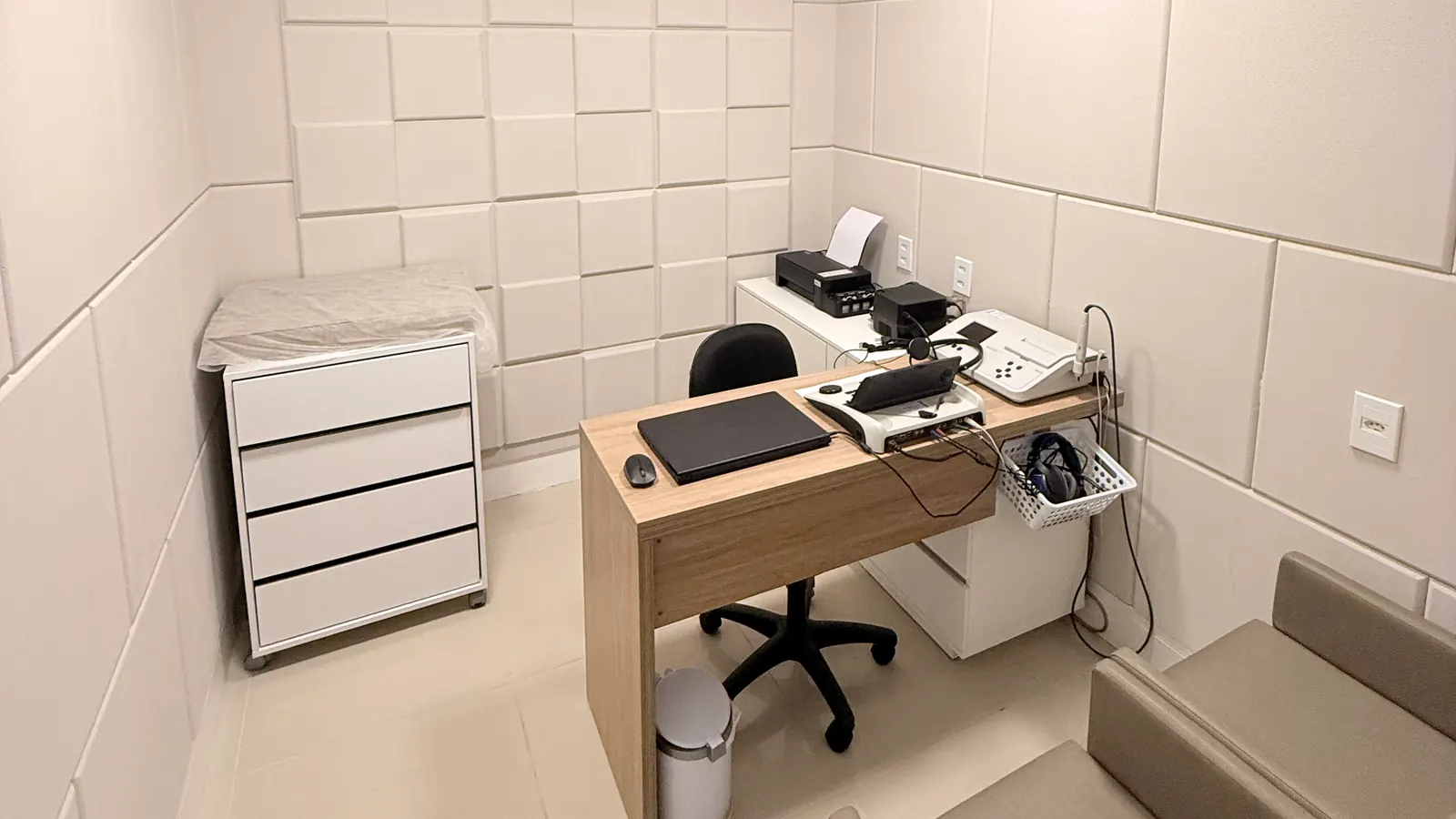
Audiometry measures how much a person hears at each sound frequency and identifies whether hearing loss is present, to what degree and of what type. It is carried out with headphones, in an acoustically treated room, and it is painless. In young children it is adapted into a game. It is the foundation of almost every hearing investigation.
Medically reviewed by Prof. Aline Bittencourt, MD, PhD, CRM-MA 7562 · RQE 1832 Updated on
What is audiometry?
Pure-tone audiometry establishes hearing thresholds: the faintest sound a person can hear at each frequency, from the lowest to the highest. The result is recorded on a graph, the audiogram.
It is usually accompanied by speech audiometry, which assesses not only whether a person hears but how much of what they hear they understand. These two pieces of information do not always travel together — some people hear the sound and cannot make out the word.
How is the test carried out?
- The speech-language pathologist talks with you and briefly examines the ear canal.
- You enter the acoustic room and put on the headphones.
- Sounds of different frequencies and intensities are presented; you signal whenever you hear one, however faint.
- Next, a vibrator placed behind the ear tests bone conduction, which delivers sound directly to the inner ear. This step is what separates conductive from sensorineural loss.
- In speech audiometry, you repeat words presented at different volumes.
In the paediatric version, sound becomes part of a game: the child fits a piece, drops a ball or points to a picture whenever she hears something. The principle is the same.
What does the result show?
| Finding | What it usually indicates |
|---|---|
| Normal thresholds on both pathways | Hearing within expected limits |
| Air conduction reduced, bone conduction normal | Conductive loss: outer or middle ear |
| Both pathways reduced together | Sensorineural loss: inner ear or nerve |
| Both reduced, with a gap between them | Mixed loss, with both components |
The degree of loss is graded from mild to profound. The report is interpreted by the ENT specialist alongside the clinical history and physical examination — the audiogram alone does not establish a diagnosis.
Who performs the test at Clínica Rhinus?
Hearing tests are carried out by the speech-language pathologists on our team, in the acoustic room at the clinic, in the Renascença district of São Luís. The result is integrated into the consultation with the ENT specialist.
How should I prepare for this test?
- Bring the medical request: it is required for all tests, whether under insurance or self-pay.
- Avoid exposure to loud noise for 14 hours before the test.
- If you have a cold or a blocked ear, let us know when booking — it may be worth rescheduling.
- Bring any previous hearing tests for comparison.
- If you wear a hearing aid, bring it with you.
Sources: Brazilian Association of Otorhinolaryngology and Cervico-Facial Surgery (ABORL-CCF) · Flint PW, Francis HW, Haughey BH, et al. Cummings Otolaryngology: Head and Neck Surgery. 7th ed. Elsevier; 2020. · Bento RF, Bittencourt AG, Voegels RL. Seminários em Otorrinolaringologia. Fundação Otorrinolaringologia.
Frequently asked questions
Questions about hearing
Does audiometry hurt?
No. The test consists of listening to sounds of different intensities and frequencies through headphones and signalling when you perceive them. There are no needles, no radiation and no contrast. The greatest discomfort is sitting in a quiet room for a few minutes.
From what age can a child have audiometry?
Play audiometry, in which the child responds to sound through a game, is usually possible from two or three years of age. Conventional audiometry, from four or five onwards. Below that range, hearing is assessed with otoacoustic emissions and ABR, which do not depend on cooperation.
What do conductive and sensorineural loss mean?
Conductive loss is when sound has difficulty reaching the inner ear, due to earwax, fluid, a perforated eardrum or a problem with the hearing bones. Sensorineural loss is when the inner ear or the auditory nerve is affected. Audiometry separates the two, and that changes the whole treatment.
Do I need a medical request for audiometry?
Yes, always. Audiometry requires a medical request, both under health insurance and self-pay. Beyond the formal requirement, the request ensures the test is interpreted within a clinical context: an audiogram in isolation, without the history and the ear examination, is of little value. Some insurers also require prior authorisation.